TikTok Engagement Calculator
Enter a TikTok username or profile URL to estimate engagement from public profile metrics.
Fetching public TikTok profile metrics...
Enter a TikTok username or profile URL to estimate engagement from public profile metrics.
Use manual mode if you want to calculate engagement from your own numbers.
Engagement by views = (likes + comments + shares) / views * 100
Engagement by followers = (likes + comments + shares) / followers * 100
The TikTok Engagement Calculator helps you estimate how strongly a TikTok audience reacts to an account or video. Enter a TikTok username or profile URL, and TikToMoney estimates engagement rate from public profile metrics such as followers, likes, videos, estimated average views, comments, and shares.
TikTok engagement is useful because views alone do not show how interested people are. A video can receive many views but very little interaction. Another video can have fewer views but strong likes, comments, shares, saves, and audience response. Engagement rate helps compare the quality of attention, not just the size of reach.
Engagement on TikTok usually means the actions people take after seeing a video. These actions can include likes, comments, shares, saves, follows, profile visits, and sometimes clicks. For most engagement rate calculations, the core public signals are likes, comments, and shares.
Engagement matters because it shows that viewers did more than scroll past the video. A high engagement rate can suggest that the content is interesting, funny, useful, controversial, emotional, or valuable enough for people to react.
There are two common ways to calculate TikTok engagement rate: engagement by views and engagement by followers. Each formula answers a different question.
Engagement by views = (likes + comments + shares) ÷ views × 100
This shows how many people interacted compared with how many people watched. It is useful for judging video performance.
Engagement by followers = (likes + comments + shares) ÷ followers × 100
This shows engagement compared with the size of the account. It is useful for comparing creator accounts, influencer value, and audience responsiveness.
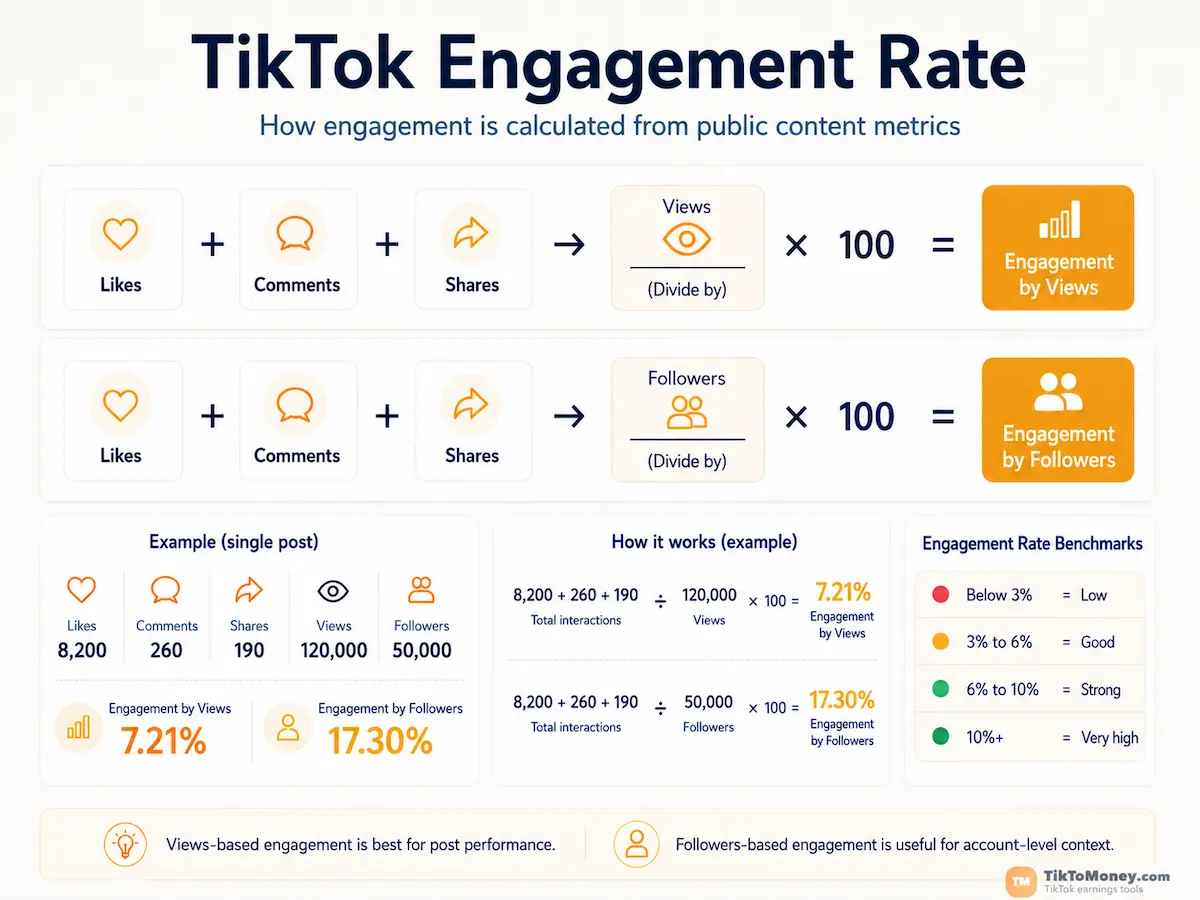
Engagement by views is usually better for understanding how a specific video performed. If a video gets 100,000 views and 10,000 total interactions, the view-based engagement rate shows how reactive the viewers were.
Engagement by followers is usually better for account-level influencer research. It helps brands, agencies, and creators compare accounts with different follower counts. A smaller account can have a stronger follower-based engagement rate than a huge account if its audience is more active.
TikToMoney can estimate engagement from public profile metrics, but the result should be treated as a benchmark. Public profile data does not reveal every private analytics metric, such as full watch time, retention curve, saves, profile clicks, or qualified views.
No. Views and engagement are different metrics. Views show how many times a video was watched or displayed according to TikTok reporting. Engagement shows how many people reacted to the content.
A video with high views and low engagement may have reached many people, but it may not have created strong audience response. A video with fewer views and high engagement may have a smaller reach but a more interested audience.
A good TikTok engagement rate depends on the account size, niche, content type, country, and whether you calculate engagement by views or by followers. There is no single number that is good for every account.
As a simple benchmark, under 2% can be weak, 2% to 5% can be average, 5% to 10% can be good, and 10% or higher can be very strong. A 20% engagement rate can be excellent, especially if it is based on real views and not a tiny sample size.
Be careful with very high percentages. A small video with low views can show a high engagement rate because the sample is small. Always compare engagement rate with views, follower count, posting frequency, and content quality.
TikTok is built around attention. Engagement helps show whether viewers care enough to interact. Likes can show approval, comments can show conversation, shares can show viral potential, and saves can suggest that the content has lasting value.
For creators, engagement can help understand what content resonates. For brands, engagement can help judge influencer quality. For agencies, engagement rate can help compare creators before paying for sponsored posts, Spark Ads, product seeding, affiliate campaigns, or TikTok Shop collaborations.
Engagement can affect earning potential, but it is not the same as payout. TikTok does not simply pay a fixed amount for likes, comments, or shares. Creator earnings can depend on eligible views, RPM, country, video length, monetization program, sponsorships, TikTok Shop, live gifts, affiliate sales, and brand deals.
Strong engagement can still be valuable because it may help a creator attract brands. A creator with an active audience may be more appealing for sponsored posts than a creator with many followers but weak comments, shares, and audience response.
TikTok does not have one fixed universal payout such as $1 per 1,000 views for every creator and every video. Creator payouts can vary based on eligibility, qualified views, RPM, region, content type, and program rules.
This is why engagement and views should be used as performance signals, not guaranteed income numbers. To estimate money, use a TikTok Money Calculator. To estimate audience response, use a TikTok Engagement Calculator.
Whether 20,000 views is viral depends on the size of the account. For a small creator with a few hundred followers, 20,000 views can be a strong breakout. For a creator with millions of followers, 20,000 views may be low.
A better question is whether the video performed above the account’s normal average. If the video gets more views, likes, comments, shares, and saves than usual, it may be viral relative to that creator’s baseline.
The 3-second rule refers to the importance of the first few seconds of a TikTok video. If the opening is slow, unclear, or boring, viewers may swipe away before the video has a chance to perform.
A strong hook can improve retention, watch time, and completion rate. These signals can help a video get more distribution, which can lead to more views and more engagement.
To increase TikTok engagement, focus on making viewers react, not just watch. The best content usually gives people a reason to like, comment, share, save, or follow.
The first seconds matter. Use a clear visual, strong statement, question, surprise, conflict, result preview, or curiosity gap. If people do not stop scrolling, they cannot engage.
Videos that keep people watching often have a better chance of getting more reach. Cut slow intros, remove dead space, use captions, keep pacing tight, and deliver the payoff promised in the hook.
Comments can be powerful when they are natural. Ask a question, invite opinions, compare options, or create a reason for viewers to respond. Avoid fake engagement bait that makes the content feel low quality.
Shares are one of the strongest signals of value. Educational tips, funny moments, relatable situations, useful lists, strong opinions, and identity-based content can all encourage people to share.
A clear niche helps viewers know why they should follow. Fitness, beauty, finance, gaming, food, education, tech, business, and lifestyle accounts can all build stronger engagement when the audience understands the promise of the account.
Engagement improves when creators test ideas and learn from their own data. Compare engagement rate across videos, not just total views. Look for topics, hooks, formats, and video lengths that repeatedly create comments and shares.
Use the TikTok Engagement Calculator to quickly estimate how active a public account’s audience is. Enter a username, check the engagement rate, then compare it with followers, estimated average views, total likes, videos, and creator level.
You can also use the advanced manual calculator if you already know the exact views, likes, comments, shares, and followers for a specific video or campaign.
If you want to estimate creator income, try the TikTok Money Calculator. For ad spend and impressions, use the TikTok CPM Calculator.
Engagement on TikTok is an audience action such as a like, comment, share, save, follow, or profile interaction. Engagement rate usually focuses on likes, comments, and shares compared with views or followers.
Add likes, comments, and shares, then divide by views or followers and multiply by 100. Engagement by views measures video response. Engagement by followers measures account-level audience responsiveness.
A 5% engagement rate can be good, especially if it is based on a meaningful number of views. The context matters: account size, niche, views, and calculation method can change how strong 5% really is.
A 20% engagement rate is usually very strong, but it should be checked against sample size. A small video with few views can show a high percentage more easily than a large video with millions of views.
No. Views measure reach. Engagement measures reactions. A video can have many views but low engagement, or fewer views but very strong audience response.
TikTok does not simply pay a fixed amount for likes, comments, or shares. Engagement can support reach and brand value, but creator payouts depend on monetization eligibility, qualified views, RPM, and other factors.
Improve the first seconds of the video, increase retention, make content more shareable, ask better questions, build a clear niche, post consistently, and compare engagement across videos.
The 3-second rule means the first few seconds must quickly capture attention. A weak opening can make viewers swipe away before they like, comment, share, or watch long enough to help the video perform.
Follower requirements depend on the monetization method. Some creator programs have eligibility rules, while sponsorships, affiliate sales, TikTok Shop, and live gifts can depend more on niche, views, engagement, and audience quality.
No. TikToMoney is an independent calculator website. It is not affiliated with, endorsed by, or sponsored by TikTok or ByteDance.